

The initial South and North Dakota outbreaks turkey flock outbreaks I mentioned in my last column have expanded as we move through September. We also added a B3.13-infected dairy cattle herd in previously negative Nebraska. The Minnesota Board of Animal Health reported its first infected turkey flock a week ago Wednesday afternoon. Michael Coston of Avian Flu Diary provided a nice review at that time of the situation in this column: Avian Flu Diary: U.S. & Canada Report More Avian Flu Outbreaks In Poultry - EFSA #NoBirdFlu Campaign
With this latest report, this brings the total number of outbreaks reported in the U.S. over the past 30 days to 16 (11 commercial, 5 backyard), in sharp contrast to last year, when only 1 commercial outbreak was reported in September.
Meanwhile, Canada's CFIA is reporting an early start as well. While they reported no outbreaks between April 11th and October 20th of last year, already they have reported 5 outbreaks across 2 Provinces (Alberta & Quebec) in September.
CIDRAP also first reported on an initial Nebraska dairy herd avian flu detection:
USDA confirms first H5N1 avian flu detection in Nebraska dairy cows | CIDRAP
The US Department of Agriculture (USDA) Animal and Plant Health Inspection Service (APHIS) today announced the first detection H5N1 avian flu in Nebraska dairy cattle, following an initial detection from pre-movement milk sampling.
Genetic analysis reveals that the virus belongs to the 2.3.4.4b clade and the B3.13 genotype seen in other dairy herds. APHIS said it is working with the Nebraska Department of Agriculture to conduct an additional on-farm investigation and gather more samples and data to more fully understand the detection and limit the spread of the virus.
The Nebraska Department of Agriculture said the herd is located in the central part of the state and has been quarantined. It added that APHIS testing suggests that the strain is similar to viruses circulating in California.
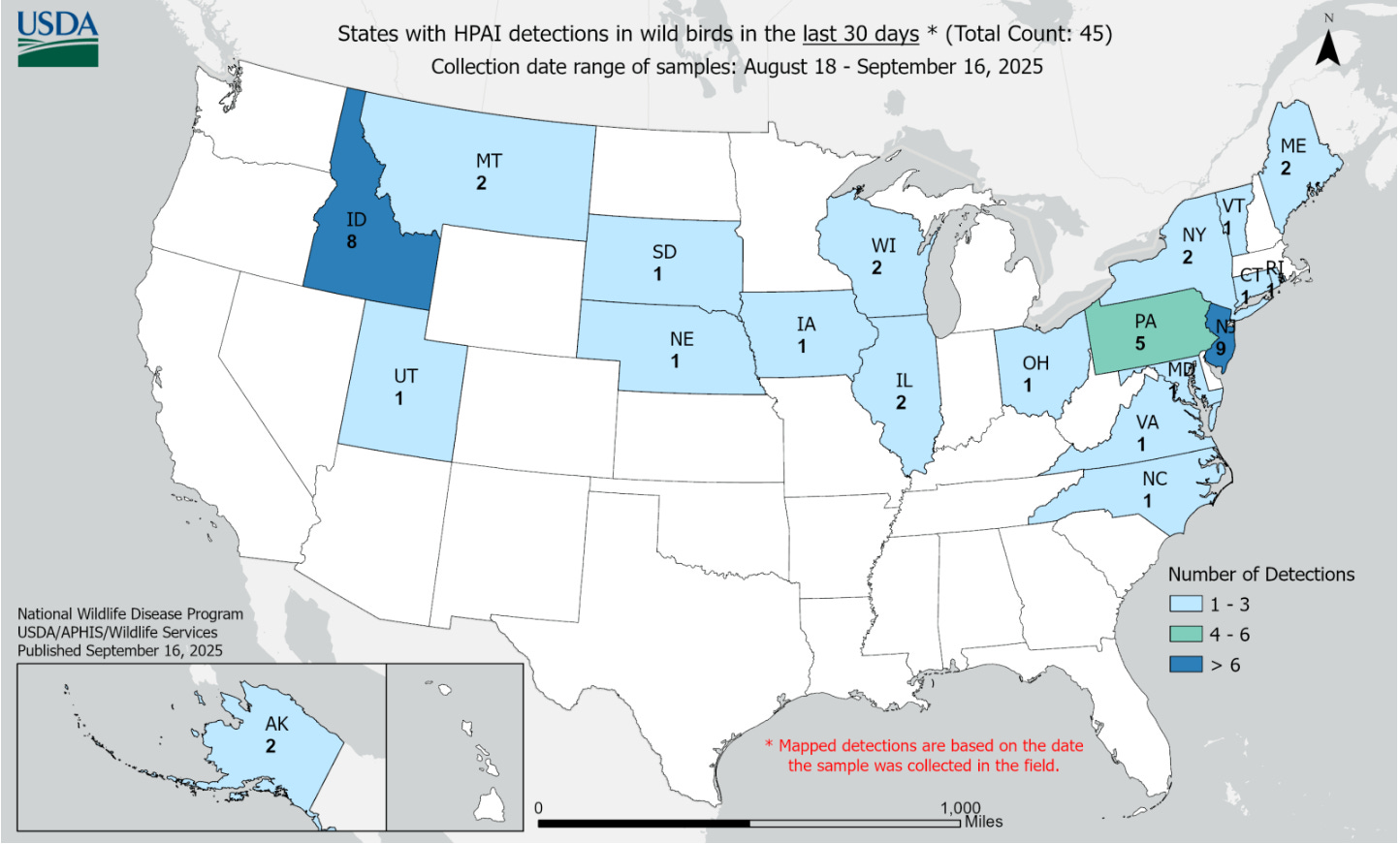
Finally, USDA APHIS Wildlife Services reported HPAI Detections in Wild Birds. Note 45 detections in the last 30 days. These are passive surveillance samples for the most part; negative northern states likely reflect lack of sampling, not lack of positive birds.
This is where I left this column last Friday when I left home for a trip to Minnesota for the Leman Swine Conference and a wonderful chance to see my new granddaughter as well as my 96-year-old mother. I have lots of new updates from Leman for future columns; in the meantime, new developments arose in all the topic areas (and more) I had begun writing about. So, let’s review them separately to digest what we now know or can deduce as of September 25th, before I fall even further behind.
Wild Birds- the Big Picture
First, Wildlife Services just released another download of data regarding detections of H5 in wild birds, reporting a big jump, with 114 detections in the past 30 days, mostly across the northern third of the nation:
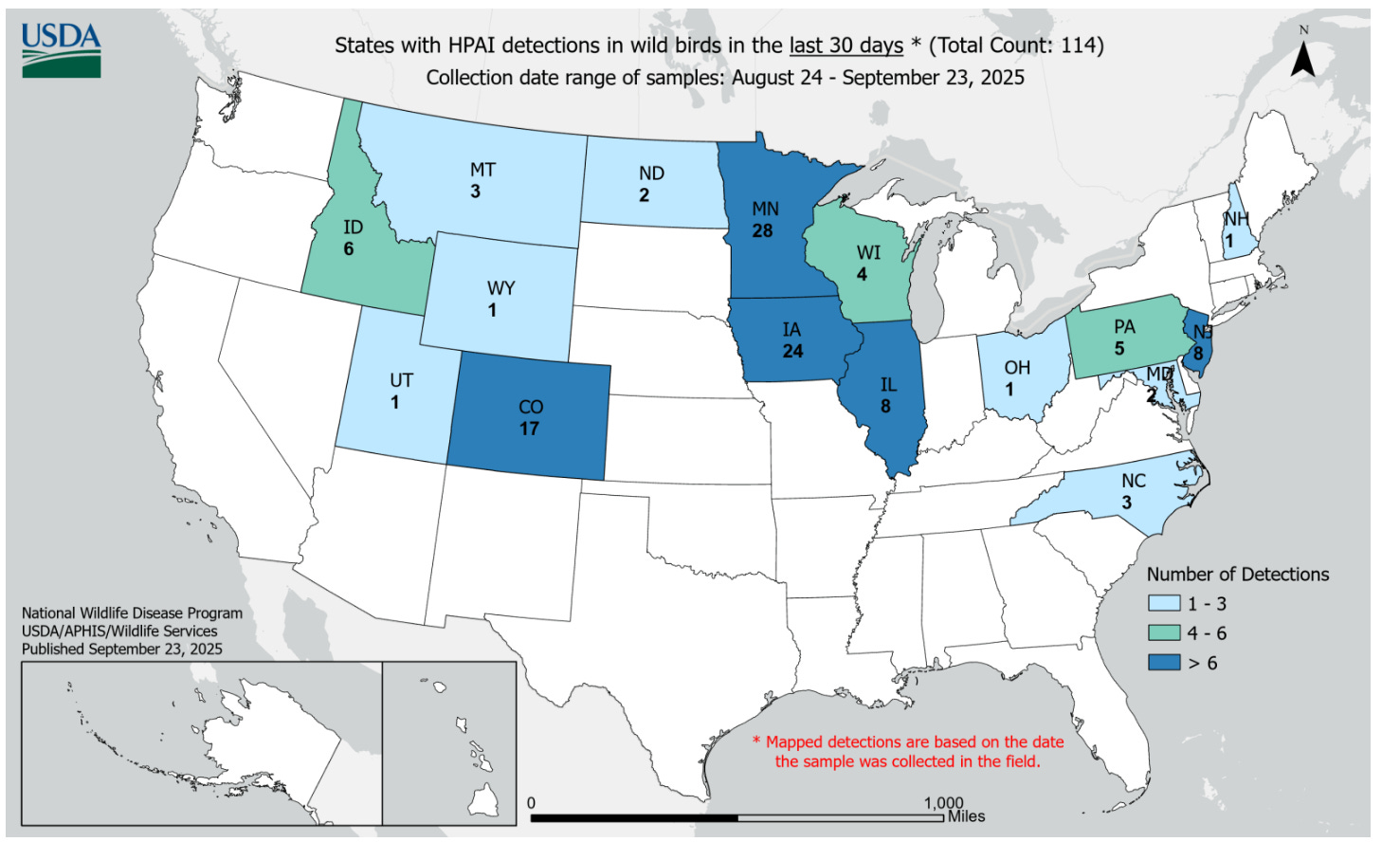
A quick review of the list shows a preponderance of duck species. We lack any denominator data (total or by species); I’m not an expert in assessing the H5 “infection density” based on this incomplete data. Perhaps others in wildlife surveillance have a better handle on just how widespread H5 2.3.4.4b infection in birds appears to be this fall versus other migration seasons. However, given this positive count acceleration and the concomitant early arrival of spillover cases into domestic poultry, it appears that we may be in for a really nasty fall HPAI season in the U.S.
Regardless, we have a somewhat robust but still under-characterized and non-representative sampling of wild bird and domestic wildlife populations - see also HPAI Detections in Mammals (which includes domestic cats). The samples we have lack detailed metadata and timely sequence information. As a result, we often know that “H5 is there”, but we don’t know detailed genotypes. Additionally, we now have real-time mapping for wild bird migrations, but no assessment of real-time HPAI status of the populations as they move with no legal mechanism to test them. This may result in “threat exhaustion” without an inkling of the level of the viral threat within the migrating populations being monitored. In our concern to not diagnose and publicize H5N1 isolates in adjacent wildlife in real time due to trade concerns, we cripple early warning capabilities for our domestic industries. (Note- I attended a seminar this morning on the WaterFowl Alert Network - I hope to cover that in future issues).
Molecular biologists outside of NVSL have very limited information on contemporary sequences that are being generated on wildlife or domestic animal viruses that are characterized internally at NVSL. Did we really intend to design a system where publicly funded diagnostic sampling results are withheld from the outside researchers, even for interim time periods? GISAID developed prompt international data sharing standards. We don’t even meet those standards within federal government research and response units.
In summary we know Wildlife Services is finding significant levels of H5N1 (likely 2.3.4.4b) in wild bird samples in the past month; we don’t know the specific genotype, so we (outside of USDA) can’t tie these samples to any outbreaks other than by suggestion. NVSL has genotypes on turkey outbreak samples and wildlife samples but does not share that information unless state veterinarians decide to do so. That comment brings us to the Nebraska dairy case…
H5N1 2.3.4.4b B3.13 in Nebraska Dairy Herd
USDA Confirms Highly Pathogenic Avian Influenza in Dairy Herd in Nebraska
WASHINGTON, D.C., September 15, 2025—Today, the USDA Animal and Plant Health Inspection Service (APHIS) National Veterinary Services Laboratories (NVSL) confirmed a detection of highly pathogenic avian influenza (HPAI) H5N1 clade 2.3.4.4b, genotype B3.13 in a dairy cattle herd in Nebraska. This confirmation was a result of State tracing and investigation, following an initial detection from pre-movement surveillance milk samples required under USDA’s April 2024 Federal Order.
The Nebraska state veterinarian was refreshingly forthright in sharing information regarding the herd detection in his state! We know that the herd was infected with the B3.13 genotype most closely related to California strains. The infection was found following an initial detection from pre-movement milk sampling. It appears that this producer was following protocol in testing milk samples from his herd prior to moving cattle interstate- kudos to all for following the regulations!
On Monday the Nebraska State Dairy Association provided updated information on the infected herd, as reported in a post on Flu Trackers by Commonground (link to oral report, with written highlight):
Nebraska Dairy Update – Nebraska State Dairy Association
The virus did not get introduced into Nebraska via migratory birds or waterfowl. Cows contracted the virus in CA and brought it into Nebraska. When they pre-test they have a 7day window before they are having to test again if they relocate those animals. In that 7days window is when the animals came showed symptoms and there is an incubation period with the virus. Now the herd is in quarantine....
I originally questioned why the National Milk Testing Strategy (NMTS) had not flagged this infected Nebraska herd. With the above explanation, it appears that the herd was likely not infected long enough to be tested under that algorithm. Rather, the testing was triggered by either subsequent cattle movement testing or by clinical signs in a cow moved into the herd on a 7-day negative PCR test from California. Either way, the herd is now under quarantine, with infection hopefully contained to that single herd. The source of infection was likely a lactating cow added to the herd from California following a negative PCR test in that state. Cows testing negative for H5N1 from non-infected herds may legally interstate movement for 7 days based on that negative test.
So what went wrong? Here are some possibilities:
The California herd may not have truly been negative, with the cow incubating an infection after the PCR test was conducted and/or there was a false negative PCR test result in California. Either way, the herd in California was not truly negative.
The cow was commingled during shipment with non-tested infected animals (either lactating or non-lactating), becoming infected during shipment.
The cow(s) were not isolated and retested prior to addition to the Nebraska herd to assure negative status.
Officials in California and in any other states recently receiving animals from the source herds are likely retesting milk and perhaps nasal swabs from the source herd and any other herds receiving cattle. If the source herd is truly negative, despite repeated testing, then more work will be required regarding biosecurity breakdowns in shipment. Phylogenetics should be helpful in narrowing down likely sources for the infection; hopefully APHIS Veterinary Services, Nebraska SAHO’s, and the California Department of Food and Agriculture have the manpower to track down all the movements - not an enviable task in many instances.
Finally, regulators and the industry need to review movement regulations in light of the latest information available regarding viral persistence in “recovered” dairy herds. Is it truly safe to ship lactating cows (or other stock) from “recovered” herds? At what time frame? Do PCR tests at the receiving site need to be added prior to allowing cows out of quarantine?
Just as with preslaughter broilers and turkeys, negative PCR test results are only valid at the time the samples are taken! Risk of false negative testing results rise every hour after samples are pulled. Seven days may make lab turn-arounds practical, but it surely is not a science-based recommendation. Shipping/receiving lactating cows is one more place where Point-of-Care H5 or even Influenza (Matrix) Milk testing could save a lot of pain in the field if only we could see our way to allow it!
Commercial Poultry
First a quick note about the South Dakota-North Dakota cluster of cases. Almost all meat turkey production in the Dakotas is ably performed within the long-standing Hutterite Colony infrastructure inhabiting parts of those 2 states, including colony-owned and managed slaughter facilities in Huron (Beadle County) South Dakota. Here is a map of most of the Hutterite Colonies of those 2 states, with Huron circled:
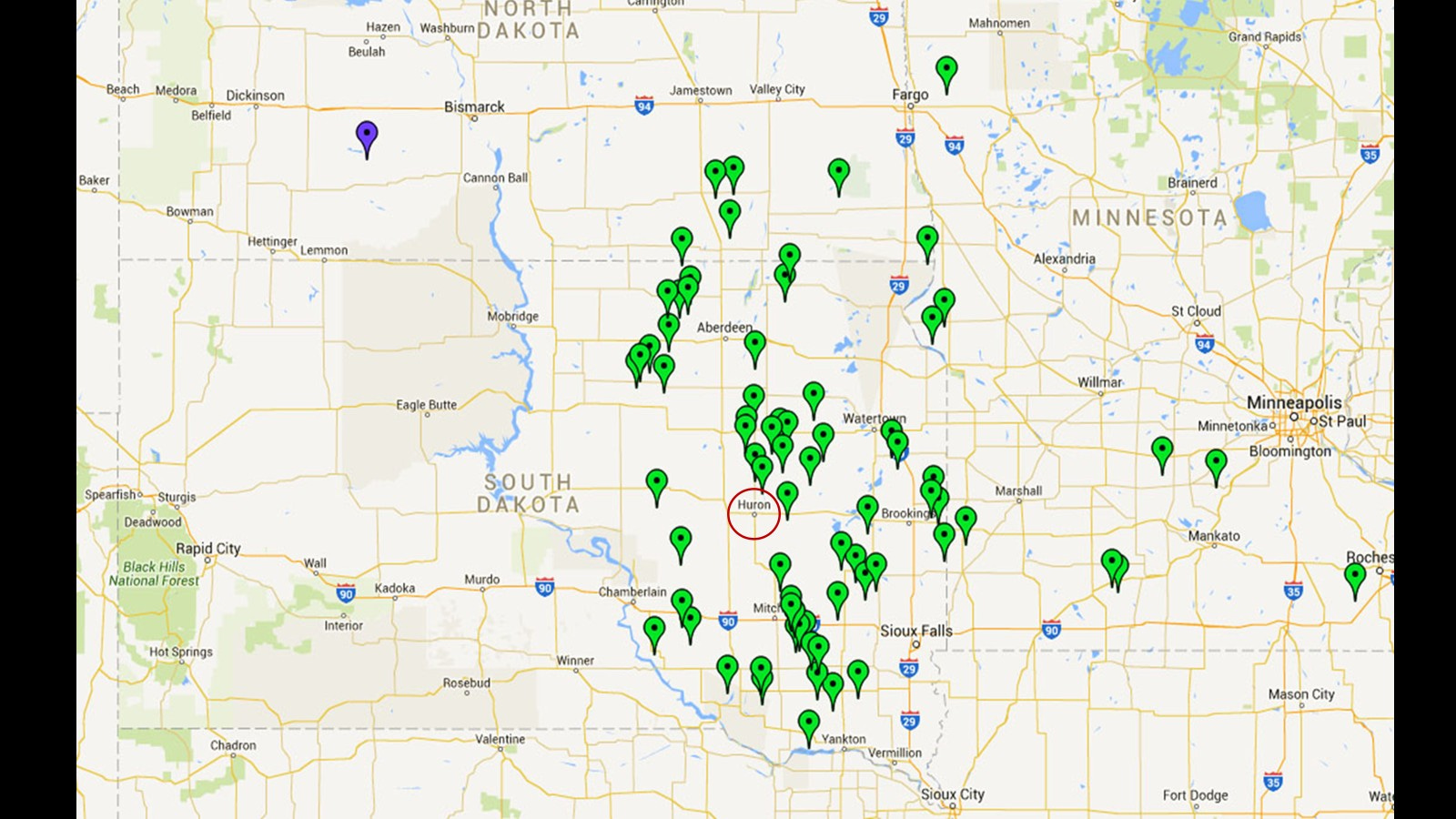
All of the counties shown with outbreaks on the NVSL HPAI case list in SD and ND fell within colony locations. Here is a link describing Dakota Provisions, the integrated turkey packing and marketing arm for the colonies.
The question in my mind regarding the Hutterite H5N1 turkey outbreak cluster revolves around the degree of relatedness between the outbreaks, i.e. were the outbreaks tied together by marketing and movement (biosecurity) links of an integrated system, or were some of the outbreaks independent introductions from wild bird spillovers? Most likely, there was some of both- those determinations are the essence of good epidemiological investigations. The public is certainly not entitled to all the details for every case; however, some sort of generalized summary from state or federal officials would be useful to understand types of introductions of infection.
OK, I’ve got to get this column out before I’m hopelessly behind the announcements…just this afternoon the Wisconsin Department of Agriculture. Trade, and Consumer Protection announced an H5N1 HPAI outbreak in a large 3.2 million bird poultry flock in Jefferson County: 2025HPAIJeffersonCo.pdf. Further details on the flock are found on this website: DATCP Home Highly Pathogenic Avian Influenza in Poultry
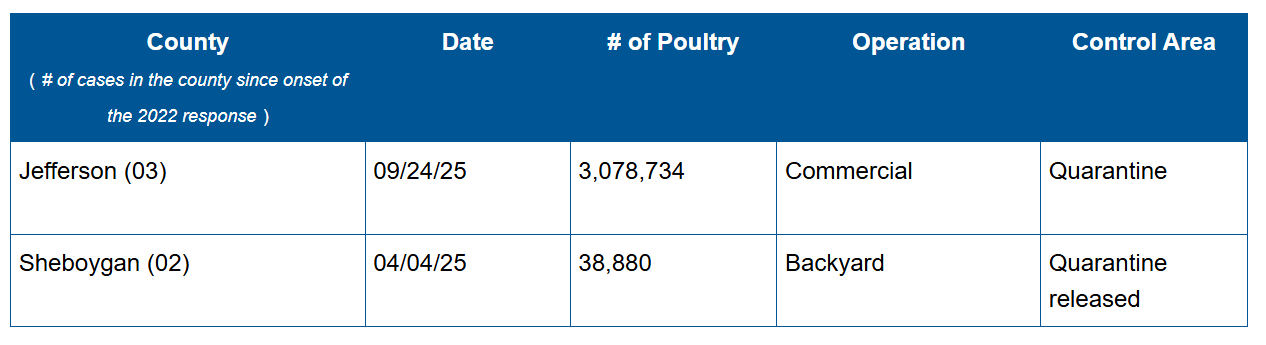
A 3 million head site practically guarantees it to be an egg layer operation, and a quick Google maps fly-by of Jefferson County indicates multiple layer operations in the county, along with several larger dairy operations. However, note that Wisconsin continues to maintain negative status on the NMTS bulk testing program, making a B3.13 spillover from dairy infections a less likely, but not impossible scenario.
At this point we must assume a wild bird spillover into the poultry operation, given the state’s northern location with domestic poultry spillovers also reported in near-adjoining North and South Dakota, Minnesota, and Michigan (plus Montana and Maryland for good measure). If the dairy industry has anything to fear, it may be that this current virus (D1.??) could directly spill over from poultry flocks or wildlife into dairy herds as an “exotic” H5N1 dairy infection, as has happened in Nevada and Arizona.
Wisconsin, and NVSL, please provide more information on the genotype of this virus, as well as the viruses from the other states. Here are some questions to answer as soon as possible:
Are viral isolates all of the same or closely related genotypes and closely related to wild bird isolates?
In states with multiple outbreaks (like North-South Dakota in the Hutterite production system, does the best evidence indicate multiple introductions via wild bird spillovers, or conversely, introduction of an extremely infectious virus that is very susceptible to biosecurity shortfalls? This is a critical question regarding the likelihood of success of more intense biosecurity protocols.
Are wild bird viral loads higher than usual, providing higher infectious doses, or is this virus infectious at lower doses, perhaps even by indirect contact (dust, aerosol, etc.)?
What are the incubation times, viral loads, clinical signs, and mortality indicators in infected domestic poultry?
Do early sequencing results show any mammalian adaptation or markers for enhanced avian pathogenicity?
Although it is early, are surrounding peri-domestic species and farm species undergoing active surveillance to assure that cross species spillover is not occurring?
Have public health authorities been notified to encourage active worker and responder sampling prior to development of human clinical signs when viral shedding is most likely to be highest?
The following list is good as of this afternoon, but will soon include at least the Wisconsin flock:
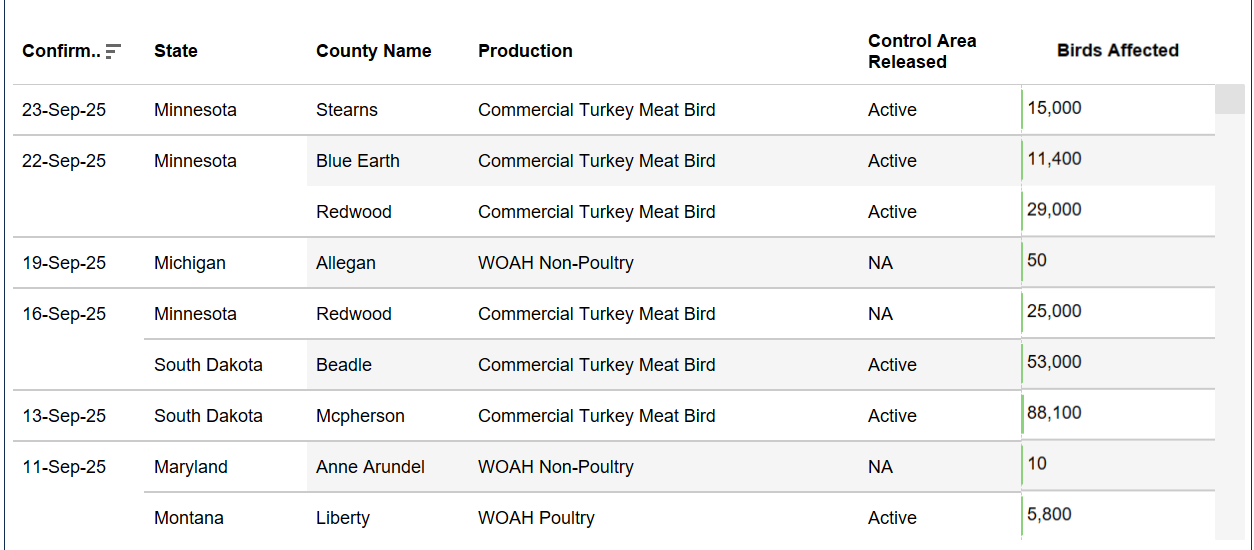
We now have 21 cases in September confirmed, counting the late August Faulk County SD case, which initiated the ND-SD run. This is not an HPAI season as usual! The entire livestock industry and One Health Community need as much information as possible as soon as possible. Waiting for the USDA public relations release or a NVSL-CEAH research preprint are not acceptable strategies in this rapidly evolving situation.
The USDA Secretary has made a big splash regarding the effectiveness of the department’s new approach to biosecurity being “the solution” to stopping HPAI in its tracks. Both the industry and the public deserve some accounting of what steps are working (or not) in this “bold new approach” to HPAI control.
John
Thanks a million for the detail oriented report. I work in veterinary research so I greatly appreciate your contribution to one health.