

Indiana poultry declared free of avian influenza | WATTPoultry.com
I wanted to start this column with good news that highlights hard work by the smaller duck and layer producers in northern Indiana teamed with the Indiana Board of Animal Health (BOAH) and their APHIS-Veterinary Services partners. Eliminating HPAI from numerous duck and layer operations interspersed in 3 northern Indiana counties was a monumental task, given the highly transmissible nature of the virus and lack of available vaccines to assist in managing immunity. It takes a lot of communications and dedication to a common mission to accomplish eradication under those circumstances.
Unfortunately, HPAI gave everyone no other option…it had to be eliminated. Summer heat and dryness undoubtedly was the dominant factor in breaking reinfections; however, I still can’t imagine the sacrifices lots of people made to come through the war. Congratulations to all! I only wish we could be confident that the victory is lasting…perhaps biosecurity lessons learned will at least minimize damages caused by possible future wildlife H5 spillovers into this and other highly susceptible areas.
Avian flu appears again in South Dakota turkeys | WATTPoultry.com
This initial 2026 case on August 12 is 16 days earlier than the initial 2025 case, which started an early 2025 U.S. HPAI fall outbreak season. On September 25, 2025, I wrote:
With this latest report, this brings the total number of outbreaks reported in the U.S. over the past 30 days to 16 (11 commercial, 5 backyard), in sharp contrast to last year, when only 1 commercial outbreak was reported in September.
Here is the 3-year trend:
2024- 1st outbreak in September
2025- 16 outbreaks in September (11 commercial) with the first on August 28
2026- first commercial outbreak on August 12th
For whatever reason, H5N1 2.3.4.4b is finding ways to penetrate commercial turkey flocks earlier in the summer in the upper Midwest, despite likely enhanced biosecurity measures. Is this apparent enhanced virus transmissibility due to: 1) a more infectious H5N1 agent, i.e. genetic changes resulting in a lower minimum dose); 2) higher viral levels in carrier wildlife; 3) altered or intensified waterfowl migration routes; or 4) just natural variability expected with n=3 seasons?
The $64,000 question now relates to the prominent genotype(s) of the presumed 2026-27 Eurasian H5 virus(es) now moving south from Canada. On Friday USDA released the following sampling data on HPAI detections in wild birds in the last 30 days, all NA-Eurasian H5 viruses.
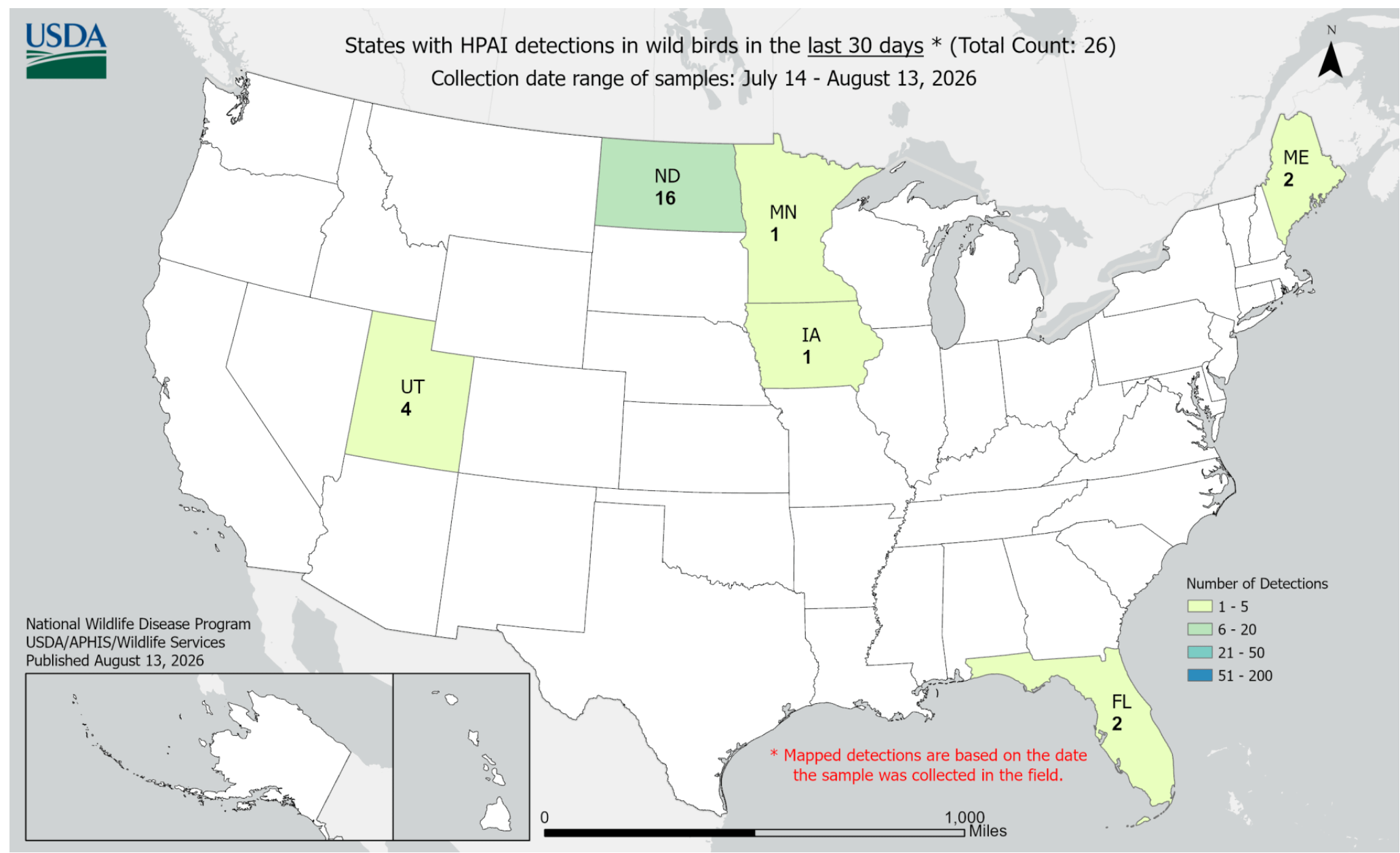
https://www.aphis.usda.gov/livestock-poultry-disease/avian/avian-influenza/hpai-detections/wild-birds?page=1
This data, plus the isolates from the infected South Dakota turkey flocks will begin to fill in the blanks on changes to the predominant genotypes and significant SNP’s in the isolated 2026-2027 strains. Early clues will also be found in any data released from Canadian sequencing efforts in samples collected from the northern extensions of the flyways. Hopefully, all parties will be releasing sequences as rapidly as practical to build a common understanding of 2026-27 HPAI viral threats in North America. The latest entries in GitHub are currently 5 months old with February 2026 detections!
Additionally, contemporary mammalian samples from affected areas are critical to understanding spillover and zoonotic risks. In reviewing the USDA HPAI Detections in Mammals web page, recent sampling has been abysmal across the U.S. outside of recent samples near affected B3.13 dairy sites plus the Utah mink.
We’ll soon know whether the turkey case in South Dakota was an unlucky premature poultry “one off” or an early harbinger of a long miserable upcoming season coming from another well-adapted virus. (South Dakota and Idaho have reported “WOAH non-Poultry” cases late last week.) The Utah mink farm case may or may not be a separate situation, depending on the genotype; B3.13 might indicate a dairy herd or poultry flock spillover. We are at the mercy of the next iterations of the H5N1 virus, once again utilizing our unchanged longstanding policies and tools against a constantly adapting viral foe. Current processes will continue until results improve, and we’ll keep guessing on genotypes until released with sufficient metadata to tie sequences to cases!
Osterholm on the Fauci Hearing Debacle
I refrained from posting earlier on the U. S. Senate Fauci hearing, given that I really had nothing constructive to add to the multiple articles condemning the whole affair for the charade that it was. However, I’d like to call your attention to one short commentary by Dr. Michael Osterholm, director of the Center for Infectious Disease Research and Policy at the University of Minnesota. Here is a link to his entire compelling commentary (Please read it all!), followed by highlights for those looking for the Cliff Notes version: COMMENTARY: The pandemic debate the US isn't having | CIDRAP
The Senate hearing featuring Anthony Fauci, MD, was frustrating and painful in its futility and pointlessness. Senators filled the proceedings with familiar arguments about decisions made during the COVID-19 pandemic…
When the hearing ended, one vital question remained not only unanswered but largely absent from the discussion: How will the United States be better prepared for the next pandemic?
That’s where Congress and the Trump administration should be laser focused….
COVID-19 exposed strengths and weaknesses across every part of our response: surveillance, laboratory capacity, communications, supply chains, vaccine development, emergency authorities, federal-state coordination, and global cooperation. Some efforts exceeded expectations. Others fell painfully short.
The United States had a rare opportunity after the pandemic to step back and conduct a comprehensive, bipartisan assessment of what happened—not to assign blame but to identify the lessons that could save lives during the next public health emergency.
Instead, day by day, our elected leaders are letting it slip away.
A body modeled after the 9/11 Commission could examine difficult questions without assuming the answers in advance. Why were some decisions successful while others failed? How should emergency authorities be exercised? What investments produced the greatest return? Where did public communication break down? How can we strengthen trust before the next crisis arrives?
Getting those answers right could save lives—tens of thousands or even millions…
Viruses do not care about politics. They do not distinguish between Republicans and Democrats, urban and rural communities, or red and blue states. The next pandemic will arrive whether we are ready or not.
History will not judge us by how effectively we re-litigated the COVID-19 outbreak or carried out personal political vendettas. It will judge us by whether we learned enough from it to protect the next generation.
Congress should establish an independent national pandemic preparedness commission with a bipartisan mandate and a fixed deadline to develop concrete proposals. The administration should support the effort.
The question before us is not whether mistakes were made. Every nation made them. The question is whether we have the courage to examine them honestly, preserve what worked, fix what didn’t, and prepare for what comes next.
That is the conversation the United States should be having. Wednesday’s hearing should infuriate and alarm every single one of us.
Every day we postpone or ignore an honest accounting of our country’s COVID performance is another day we lose preparing for the next big one.
We will one day measure our success or failure to seize this opportunity in lives saved or lost.
I’m under no illusions that the current administration or Congressional leadership has any intent to move the needle on these issues. We are frozen in time until after the Fall 2026 elections at the earliest, unless nature forces a reaction earlier with a new, likely tardily defined pandemic.
More ominously, the federal and state infrastructures involved in pandemic planning and preparedness has been severely eroded under current policies and funding cuts. Offices and people at the center of coordinating any new pandemic planning and preparations are no longer in place. It will take time and a new administration with renewed priorities for pandemic preparedness to capture Dr. Osterhom’s vision. While he advocates a Congressionally mandated independent commission, lack of bi-partisan leadership in our moribund Capitol Hill political environment means that we are likely doomed to repeat our uncoordinated executive branch reactive responses to new zoonotic disease threats.
Stakeholders and the public expect consistent predictable responses from their respective governing agencies, be that HHS-FDA-CDC complex, DHS, or USDA. Agencies involved and their powerful stakeholders operate under complex understandings and negotiations that result in “following the CFR (Code of Federal Regulations)”.
However, a novel pandemic threat may well require relatively harsh responses at odds with long established CFR understandings with very short notice, while lacking gold standard evidence for requiring such an action, resulting in the need for “Emergency Rules”. As we discovered with COVID19, best practices change as knowledge and tools advance, immunity progresses, and the virus changes. Every right move today becomes a wrong move someday or in some subpopulation or some area. Emergency Rules are painful to some but often well accepted on a short-term basis due to an emergency situation. However, good will wears thin as time drags on and conditions and scientific assumptions that necessitated the rule change(s) continue to change and be proven obsolete or just plain wrong.
The real challenge for leaders is rapidly making critical needed changes during a public health crisis. Bureaucratic paralysis is often more harmful than overreach in a hindering evolving pandemic responses. As an example of a paralyzed policy change, public health faced a testing bottleneck with COVID19 in early 2020 when CDC refused to grant waivers for extending approved PCR testing beyond their flawed PCR COVID test, which was in critically short supply in the face of burgeoning compatible cases requiring testing. The natural response to a shortage of official tests was to narrow the human case definition to limit official testing required, which only added to the lag in official case counts. Thus the U.S. had a significant lag time in understanding the scope of the COVID outbreak during its logarithmic growth phase in multiple states.
Inflexible National Official Testing Requirements became counterproductive in understanding the scope of the pandemic during its most crucial assessment phase! However, HHS-CDC was unwilling to modify its official testing standards to allow use of the WHO PCR test which could have relieved the backlog. Bureaucratic paralysis is often more harmful than overreach in pandemic response; in this case it singlehandedly prevented a more accurate leading count of newly diagnosed COVID19 infections, soon enough confirmed by morbidity and mortality numbers (with graphic reefer morgue pictures) in affected areas.
The COVID saga certainly brought forth many other examples of decisions later shown to be incorrect or suboptimal. Public support for emergency rulemaking and unpopular edicts inevitably erodes over time, especially when reversed decisions are not adequately explained based on changing information (e.g. mask usage guidelines, school closures post vaccination, outdoor gatherings).
Despite all the political setbacks to public health flowing from the COVID19 pandemic, it also generated cutting-edge technology in diagnostics, treatment, epidemiology and vaccinology (mRNA vaccines have saved millions of lives and will save millions more). Unfortunately, technology evolves much faster than policy, where stakeholder’s perceived self-interest, pride and institutional hubris get in the way of faster adaptations to changing risks and opportunities for advances in preparedness, early detection, and response innovations
I’d predict that in the next 5 years we will learn to aggressively aggregate disparate data (via AI) from actively and passively collected indirect risk-based targeted molecular signals in water, air, sewage, retail products, wildlife, etc., tied to time and locations of varying specificity. This will result in heat maps of zoonotic risk, allowing public health officials to target human contact and potential sampling efforts.
Producer will have the opportunity, but not the requirement to add farm-level data to the picture. Marketing outlets may or may not require farm-level sampling as a condition for selling agricultural products. Sampling for food safety, animal health and zoonotic risks may well meld together in this process- the same sampling substrates will be useful for all applications. Actually, the cross use of the sampling algorithms is what will drive its cost-effectiveness and compel its use.
Cyclospora, E. coli in eggs, and H5N1 are just contemporary examples of pathogenic threats that can be monitored in real time in our food system environments that must be detected earlier than they are now. It will be done because it must be done. Producer cooperation in gathering adequate phylogenetic data for zoonotic disease risk assessment will no longer be critical when alternative sources of sampling and data aggregation are available. The Taylor Farms lettuce debacle is the latest example of the dead-end publicity that results when producers stiff consumer safety concerns. Producers can choose to work with consumers or around them, but safety and consumer choice will eventually win out. Am I the only one actively avoiding Taylor Farms labels at Costco?
A Lab Leak that Really Happened…Kind of
Here is a fascinating account of the return of H1N1 to humans. I hadn’t fully realized that in Iowa in the 1960’s, our pigs had H1N1, while we as humans didn’t! The virus was quite seasonal in pigs back then and apparently didn’t jump back into people until a brief incident at Fort Dix MD in 1975 - which led to an aborted vaccine plan for the U.S. and then another “secret” vaccine program in Russia including a modified live vaccine or a challenge strain…oops…
But don’t take it from me- read the whole story here- I find it fascinating:
The return of H1N1: Reemergence of the influenza virus A subtype H1N1 in 1977 - ScienceDirect
It seems to me that H1N1 was destined to reemerge in people given its reservoir in swine, especially as the swine industry intensified into continuous year-around production with a more continuous active H1N1 swine viral reservoir in contact with human caretakers. The world would soon be in need of a new human H1N1 vaccine. The Fort Dix infection originated from a pig somewhere, although it died out. However, the H1N1 viral dispersion from Russia in 1977, likely from a poorly conceived vaccine experiment, provides another lesson in the high stakes for ongoing international professional review and approval of standards for containment prior to proven safety in research and development.
H5N1 2.3.4.4b Zoonotic Transmission Risks
Eurosurveillance recently released a paper:
I had hoped that the study might provide new material on refining the risks for viral transmission during avian flu outbreaks from poultry flocks to people. However, the study contained one huge confounder, use of PPE! Unsurprisingly, the study found that transmission to people utilizing PPE was rare, although it did occur. From the study:
Although no severe illness was reported, Cases 5 and 6 reported coryza and conjunctivitis, respectively. Case 6 was symptomatic when interviewed for the study, and was precautionarily hospitalised, despite having only mild symptoms. None of the six cases had received the seasonal influenza vaccine nor had taken antiviral medication before their positive test result. Cases 1 and 6 reported not wearing full PPE during their exposure (which started before their corresponding site’s outbreak confirmation), giving a 3% (2/63) positivity rate in those exposed without PPE, and a 1% positivity rate in those exposed with PPE (4/365). Four of the cases were staff involved in the culling operation; two were permanent farm workers. Five of the cases were exposed to chickens, and the remaining case, of ‘uncertain significance’, was exposed to turkeys. All six cases were exposed to the birds by touch, and four to bird waste.
The numbers are too small to be significant, especially given the voluntary nature and self-testing structure of the study. However, even a 1% positivity result WITH PPE use is concerning! The 3% positivity result without PPE leads me to wonder just how much infection resides in workers exposed to non-clinical viremic poultry populations prior to official clinical diagnosis, when aerosol viral levels in poultry barns are likely to be extremely high? We don’t know because these are exactly the populations we are neglecting to test or even to find!
All of our studies, including the one above rely on work in officially diagnosed flocks, after depopulation has commenced, likely after peak aerosol viral loads have passed as live birds are euthanized and workers are fitted with PPE. While we can argue that if we thought there is a risk all workers should wear PPE, the reality is that PPE is NOT used until disease is diagnosed. That step does not occur now until clinical signs develop, and a sample is tested provisionally positive at a NAHLN lab on its way to NVSL for confirmatory testing. The tragedy is that neither birds nor workers are protected at the point of greatest risk for infection, because we don’t have approved tools for environmental screening for preclinical viral build-up!
In a column dedicated to swine last October, Swine Influenza - More Complicated Than We Ever Imagined, I wrote about the degree of spillover of human influenza virus from humans into swine herds that has been documented, including issue it has caused for producers attempting to take multiplier gilt farms negative. Non-clinical viral shedding humans shed virus to susceptible pigs.
I’d propose that the same mechanism is certainly plausible for pre-clinically infected poultry shedding virus to humans, who may develop sub-clinical PCR+ transient infections (and possibly later SN and/or ELISA titers) from exposure. This is a potentially significant biosecurity issue for the poultry industry, given personnel travel between flocks prior to quarantines. Let’s test 1000 volunteers at breaking poultry sites to prove me wrong.
Influenza is a shared virus…
John
Thank you